Relay
We helped Relay replace email chains and Slack threads with a structured approval system — so nothing gets lost, every decision is traceable, and finance teams can stop chasing and start leading.
Approval requests were disappearing into Slack threads and reply-all chains.
Finance teams at multi-entity companies had no structured process for approvals. Purchase requests, headcount sign-offs, vendor contracts — all handled over email or Slack, with no visibility, no routing logic, and no record of who approved what, or when.
"I have no idea which requests are sitting in someone's inbox right now. I find out when it's already late."
The result: payments delayed by days, compliance gaps that showed up during audits, and finance leads spending their mornings chasing approvals that should have been handled without them.
No routing logic — requests landed with whoever was easiest to reach, not whoever had authority to approve
High-value requests treated the same as low-value ones — no prioritisation, no escalation rules
No audit trail — compliance couldn't prove who approved a $62,000 infrastructure upgrade or when
CFOs spent hours each week manually chasing approvals across entities instead of reviewing decisions
Requests regularly sat unactioned for 5+ days — blocking vendor payments and onboarding timelines
Map the process before designing the product.
The temptation was to design a better inbox. We pushed back — the problem wasn't where requests lived, it was that there was no structure around them at all. We had to design the workflow logic before we touched any UI.
People weren't ignoring requests — they genuinely didn't know what needed action. Visibility was the core problem. Once the queue existed, approvals moved on their own.
Early designs showed the full approval chain upfront. Testing showed approvers didn't need to see the chain — they needed to see the request. The chain moved to a secondary panel, action became the primary UI.
Email notifications were cut from v1. Controversial — but the data showed approvers were checking the queue daily once they had it. Notifications shipped in v1.3 with usage data to justify the priority.
Four screens. One complete system.
Rather than patching the email problem, we replaced the entire approval process — from how workflows are defined, to how requests are reviewed and traced.
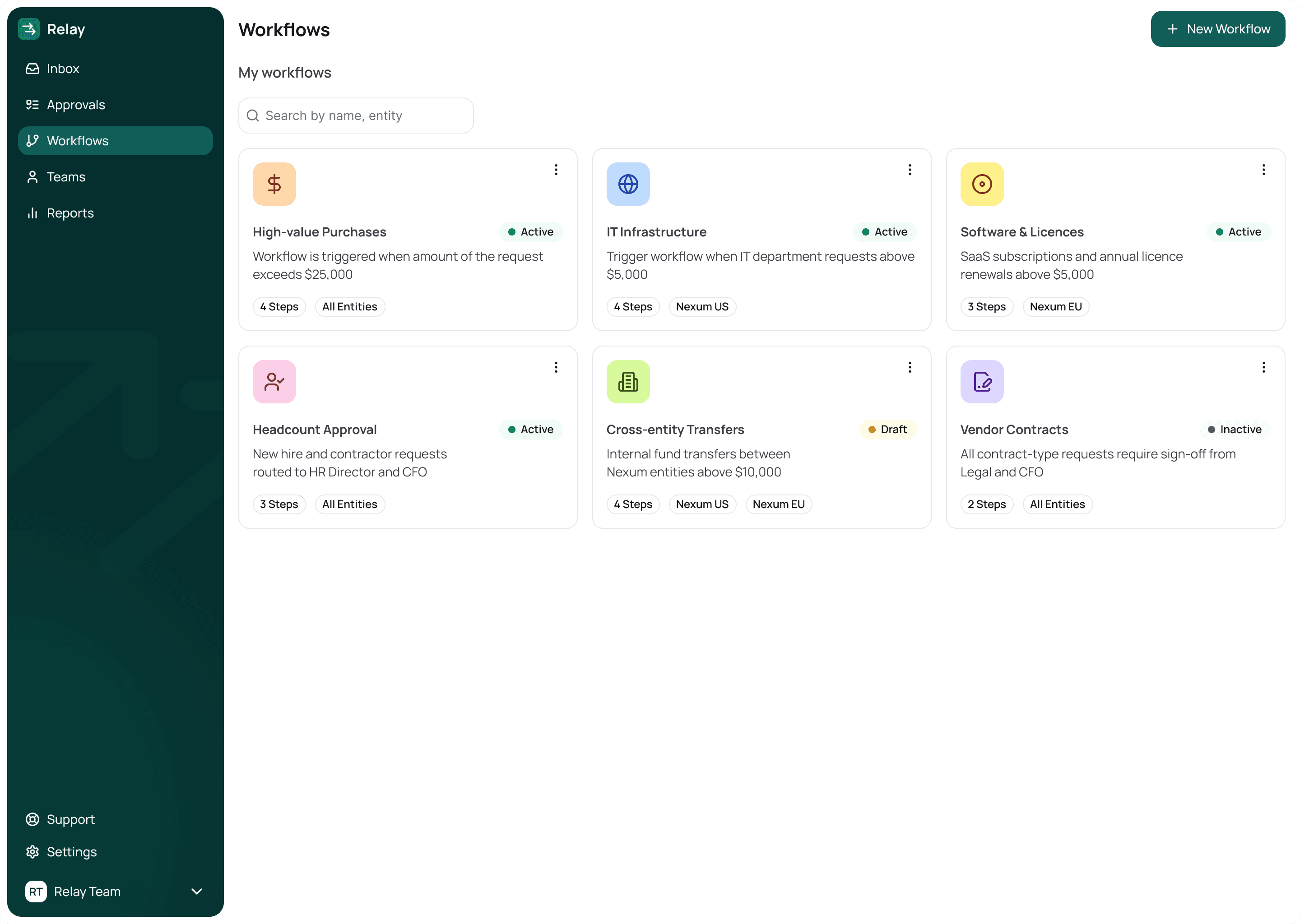
Approval rules defined once, applied everywhere.
Before Relay, every approval was handled ad hoc — whoever was available, whatever channel was fastest. We replaced that with a structured workflow library: named rules that define what triggers a request, who reviews it, and in what order.
Workflows apply across all entities simultaneously. A High-value Purchases rule configured once covers UK Ltd, Ireland Ltd, and Germany GmbH — no duplication, no drift.
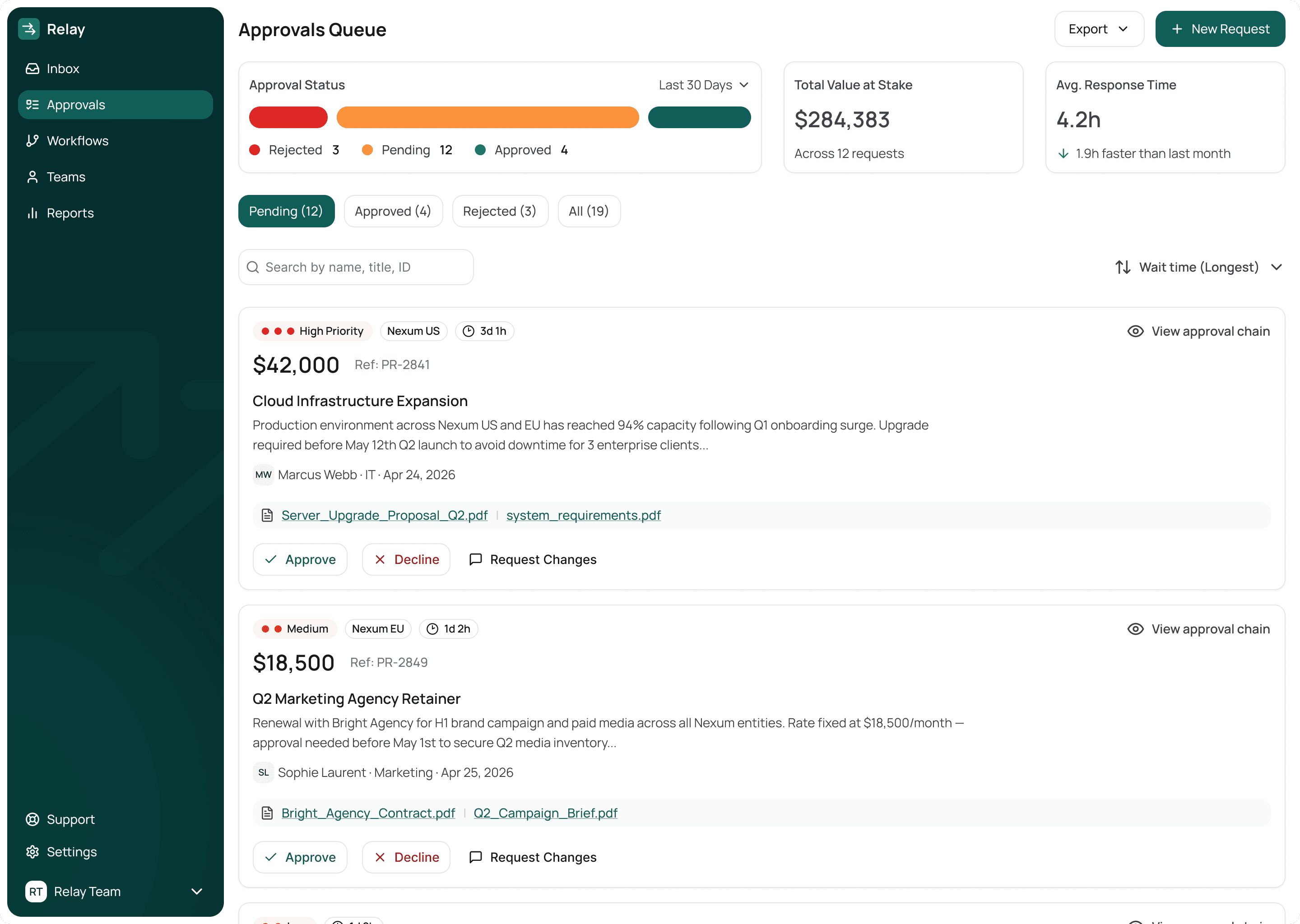
Everything that needs a decision, in one place.
The queue replaced the inbox. Finance leads no longer had to monitor Slack channels, email threads, or individual tools — every pending approval surfaces here, sorted by priority and wait time, with total value at stake visible at a glance.
High-priority requests are flagged immediately. Avg. response time is tracked in the header — a subtle but effective nudge that kept teams accountable without requiring a manager to chase anyone.
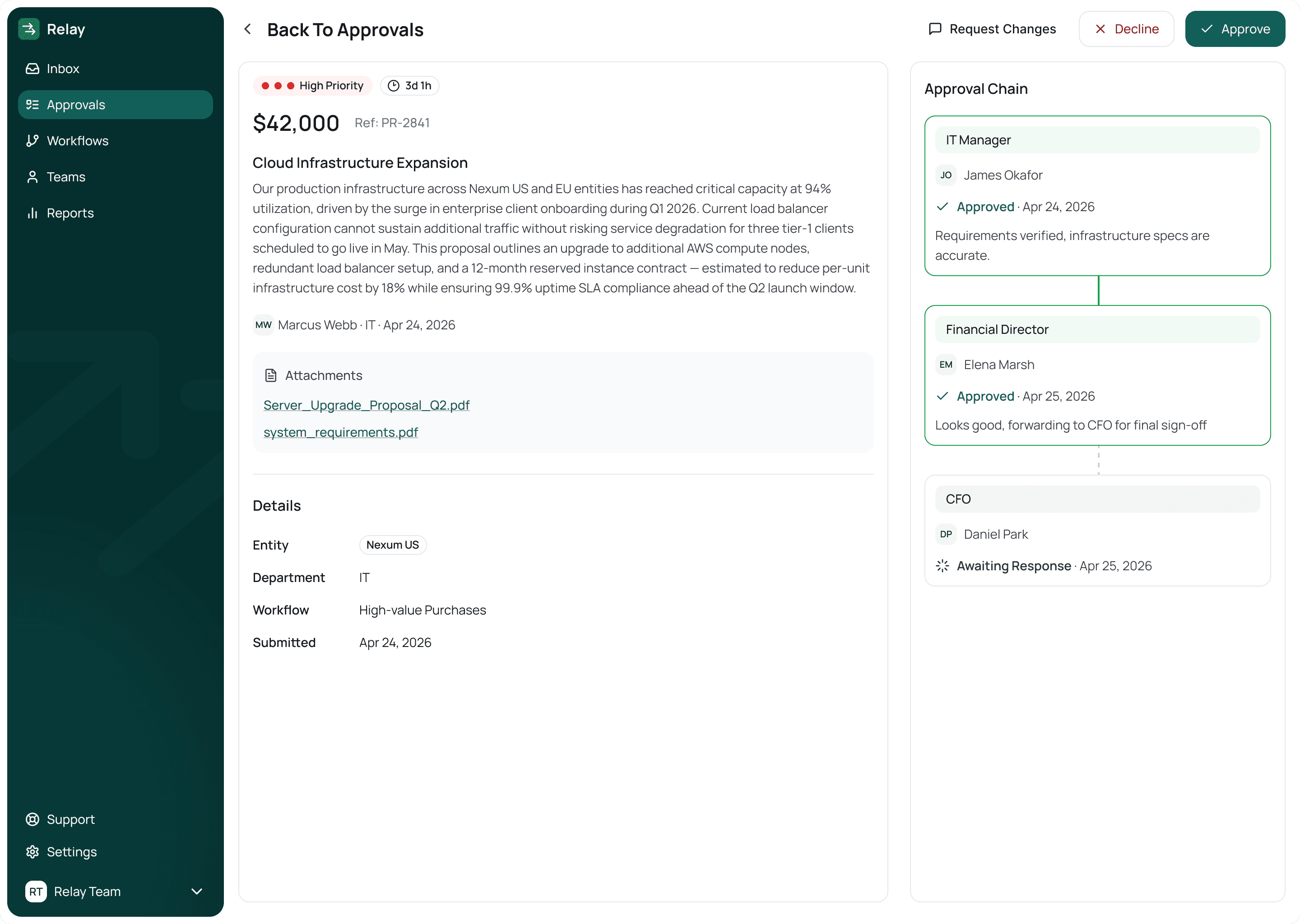
Full context. Full history. One screen.
Every request opens to a full detail view: the ask, the business justification, attachments, entity context, and a complete approval chain with names, timestamps, and comments at every step. Compliance now has an audit trail that requires zero extra work to maintain.
Approvers can action directly from the detail view — approve, decline, or request changes with a single click. No switching tools, no email reply, no lost thread.
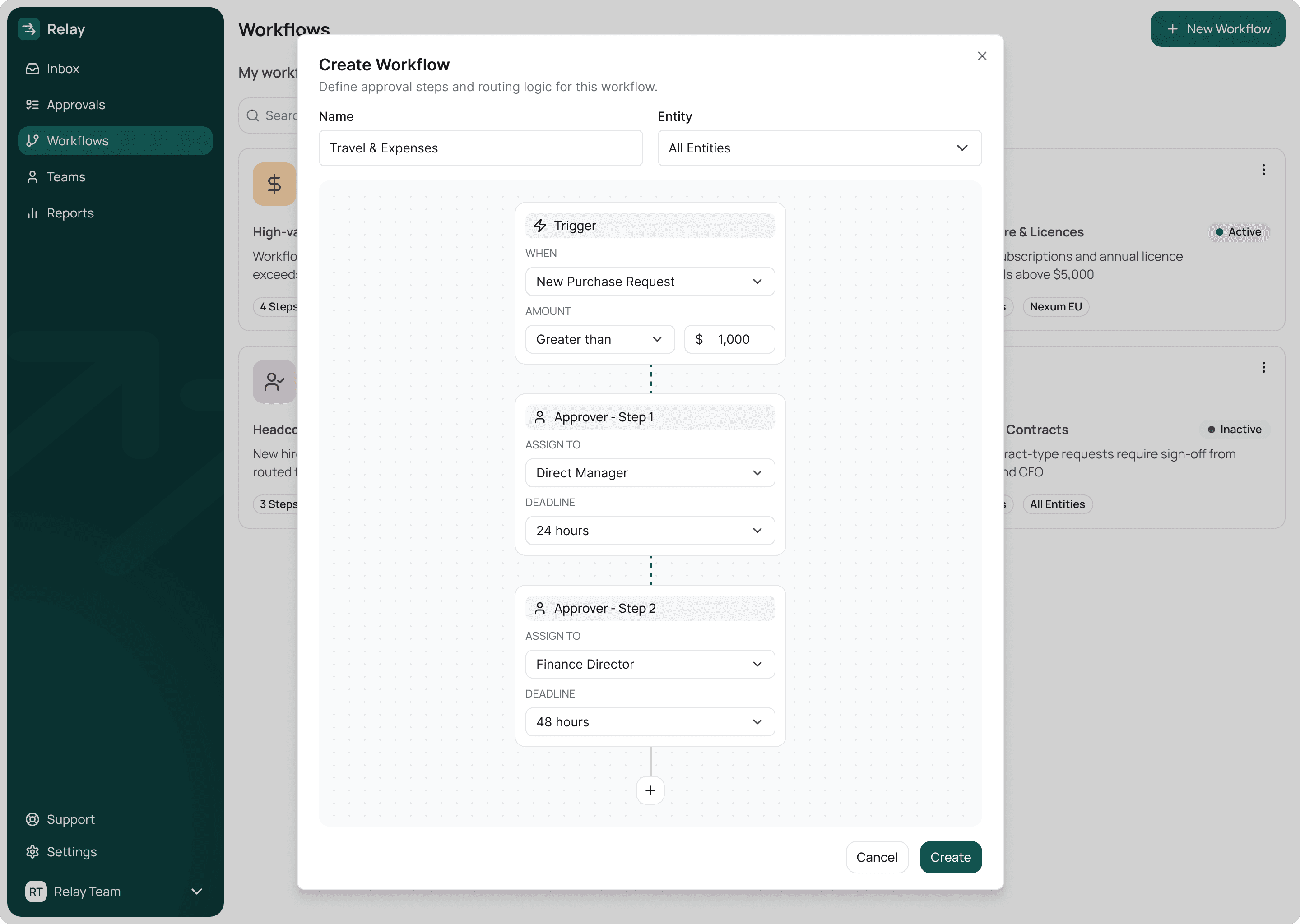
No-code routing logic, configurable by finance admins.
The hardest design challenge on this project. We needed to support complex multi-step routing — trigger conditions, step-by-step approvers, entity scoping, deadlines per step — without requiring engineering involvement to configure or change rules.
The builder went through 4 major iterations. The final version lets finance admins create a full multi-step workflow in under 3 minutes — tested and confirmed with 5 non-technical users before shipping.
Numbers that speak for themselves.
Measured across the pilot group — finance managers, approvers, and CFOs at companies managing approvals across 3–8 entities.
Before Relay, roughly half of all approval requests were sitting unactioned past their deadline. At 3 months, that number had dropped to near zero. The queue made the problem visible — and visibility alone solved most of it.
Every approval fully timestamped and attributed. Compliance audits that previously required manual reconstruction now take minutes to pull.
Down from 5 days. Approvers actioned requests the same day — not because they were pushed to, but because the queue made it frictionless.
Process design is product design.
The hardest part of this project wasn't the UI — it was understanding the workflow logic well enough to design something genuinely flexible without making it overwhelming for the people who had to use it every day.
Most approval tools are built for requesters. Bottlenecks happen at the approver level. The deliberate choice to design the queue and request detail primarily for Finance Directors and CFOs — not for the person submitting — was the single decision that unlocked the core metric improvement. Getting that framing right early is what design research is for.
The workflow builder had to support genuinely complex logic — multi-step chains, conditional routing, entity scoping. But the people configuring it weren't technical. Getting that balance right took 4 iterations and 5 rounds of testing with real finance admins. There are no shortcuts here, and any agency that tells you there are is wrong.
The biggest improvement in overdue approvals came not from reminders or escalation logic — it came from the queue simply existing. When approvers could see exactly what was pending and for how long, they acted. We shipped the simplest possible version first. The data proved it was enough.
The audit trail wasn't on the original product brief — it came up in the first research session and never left. Finance teams weren't asking for compliance tooling; they were asking to stop dreading audits. Reframing the feature around that emotional job-to-be-done changed how it was prioritised, built, and sold. Research surfaces the right problems. Design makes them solvable.
Vantra
Redesigning multi-entity financial management — 94% reduction in reconciliation time, 67% faster cross-entity reporting.