Vantra
We helped Vantra replace a four-tool spreadsheet process with a unified finance OS — giving controllers real-time visibility across entities and cutting cross-entity reporting time by 67%.
Finance data was everywhere. Insight was nowhere.
Multi-entity finance teams were managing their books across four different tools — and stitching the picture together manually, every single week. The process wasn't just slow. It was error-prone, exhausting, and structurally incapable of giving leadership what they needed.
"By the time the report lands in my inbox, the numbers are already 72 hours old."
By the time a CFO received their weekly report, the data was already stale. Decisions got delayed, opportunities got missed, and controllers burned the better part of three days a week on work that added no analytical value.
Four-tool finance stack — controllers manually pulled from Stripe, QuickBooks, Xero, and a payroll system into a master spreadsheet every week
Reconciliation took 3.1 days per week — leaving less than two days for actual analysis
Cross-entity reporting was a manual consolidation job — each entity had its own format, its own cadence, its own version of the truth
CFOs were reading reports that were 72+ hours old by the time they landed — decisions made on stale data
No single source of truth across entities — different teams, different currencies, different close processes, no unified view
Understand the data model before designing the interface.
Finance tools fail because designers treat the data as an afterthought. We started with the underlying data model — entities, currencies, consolidation rules — and worked forward to the UI from there.
Controllers weren't bad at their jobs — they were doing a job that shouldn't exist. Every hour spent on reconciliation was an hour not spent on analysis. The product's job was to eliminate the manual process entirely, not make it slightly faster.
We initially designed a single dashboard for all users. Research showed CFOs and controllers needed fundamentally different entry points. The CFO view was added mid-project — it wasn't in the brief, but it became one of the most-used features at launch.
Bulk-edit was cut from v1. The data showed reconciliation accuracy mattered more than edit speed at launch. The feature shipped in v1.2 — better for having waited, because by then we had real usage patterns to design against.
Four screens. One finance OS.
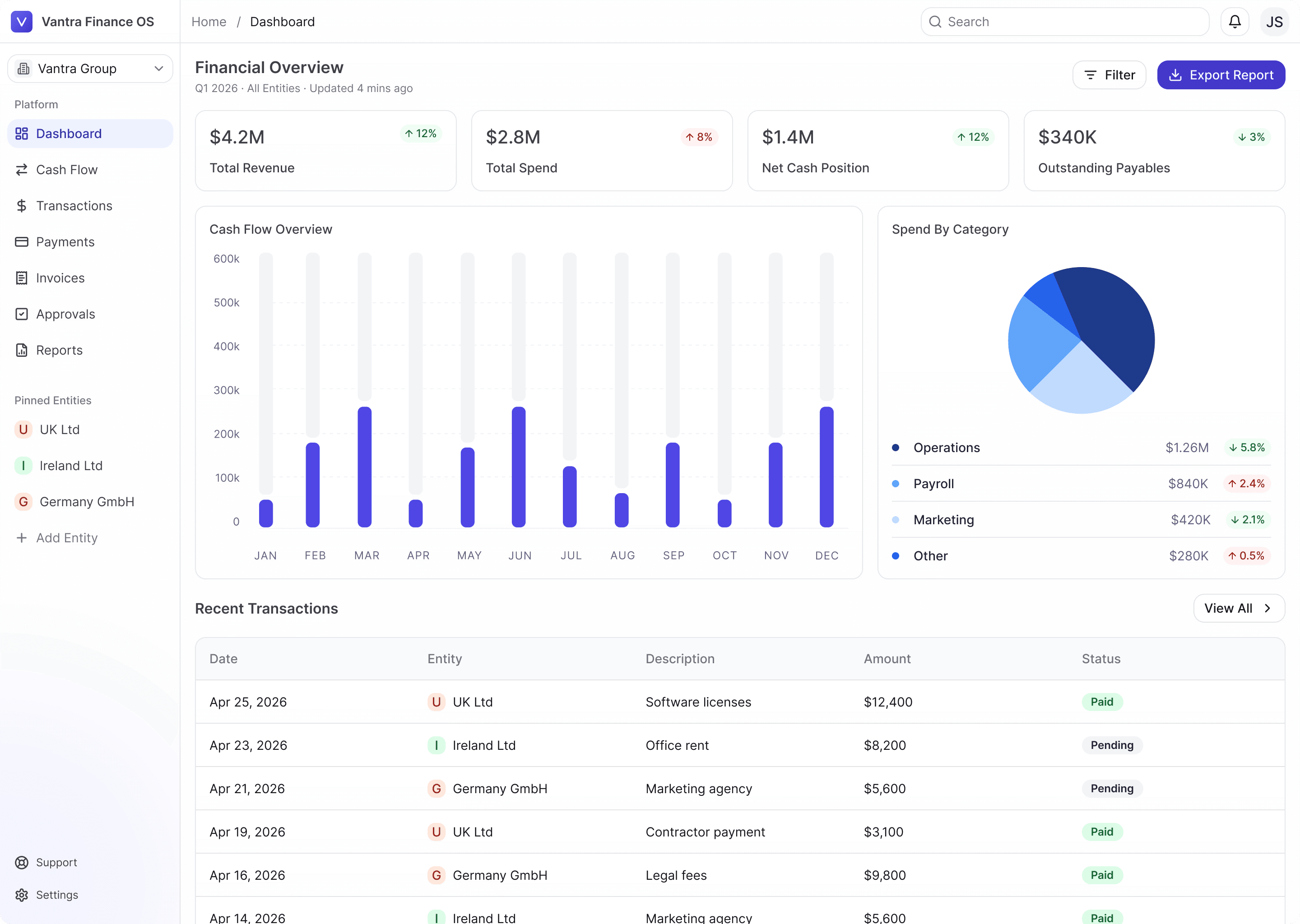
Rather than improving the spreadsheet workflow, we replaced it — connecting every data source into one place and giving every stakeholder the view they actually needed.
All entities. All data. One view.
The reconciliation dashboard pulls live data from every connected source and presents a single, consolidated view across all entities. No manual imports, no stale exports — the numbers are current the moment you open it.
Discrepancies are flagged automatically with context: which entity, which account, what the delta is. Controllers go straight to the problem instead of hunting for it.
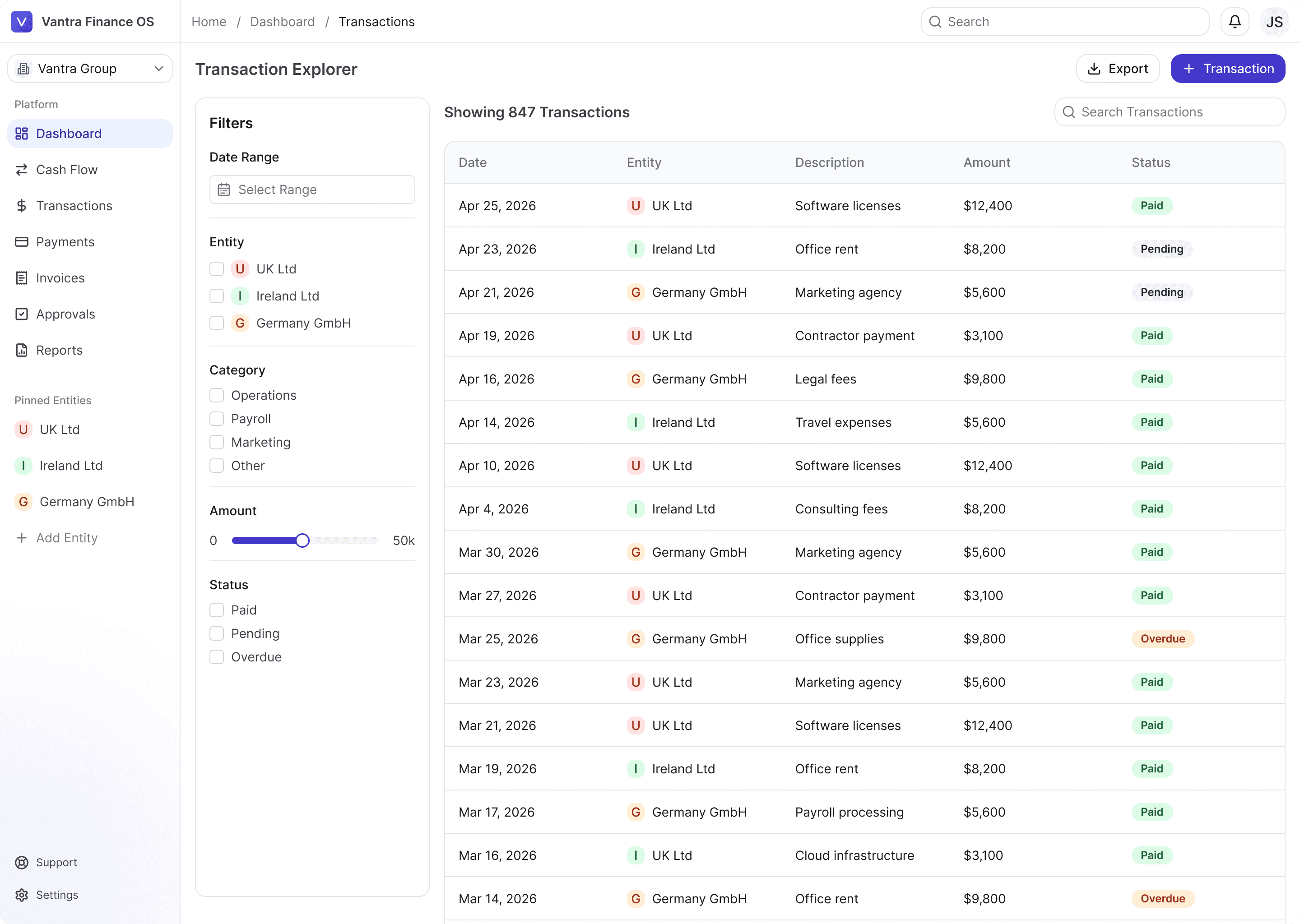
From summary to source in two clicks.
Any figure on any report is clickable. Every number traces back to the underlying transactions — with counterparty, date, and entity context. The audit trail builds itself.
Finance managers told us this alone removed the most painful part of their week: rebuilding context every time a number looked wrong.
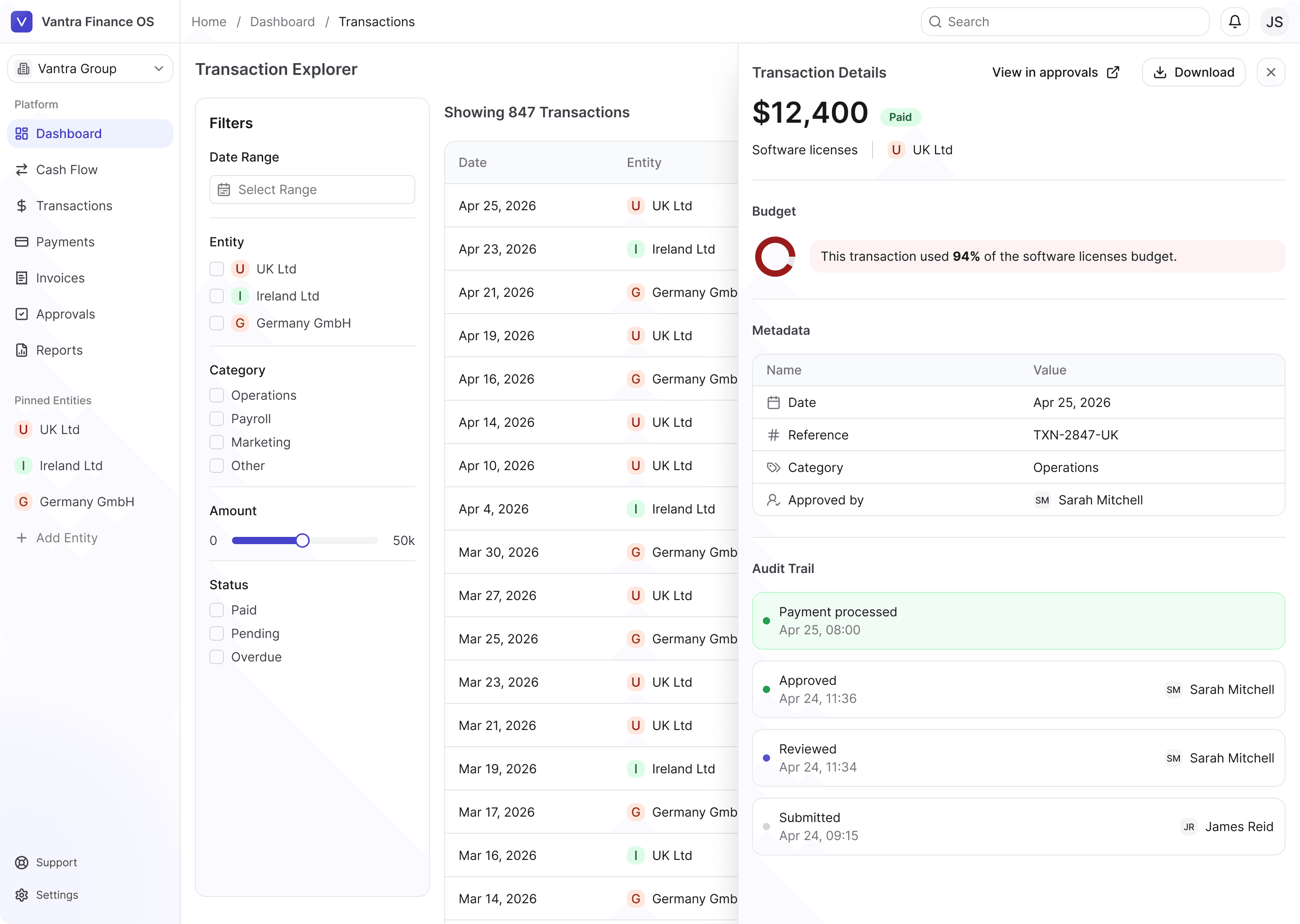
Know where every decision stands.
Cross-entity payments, intercompany allocations, and budget exceptions all flow through a single approval view. Status is live — no chasing, no status meeting required to know where things are.
The notification system surfaces blockers before they become delays. Finance leads see what's overdue and what's coming — not what already missed its window.
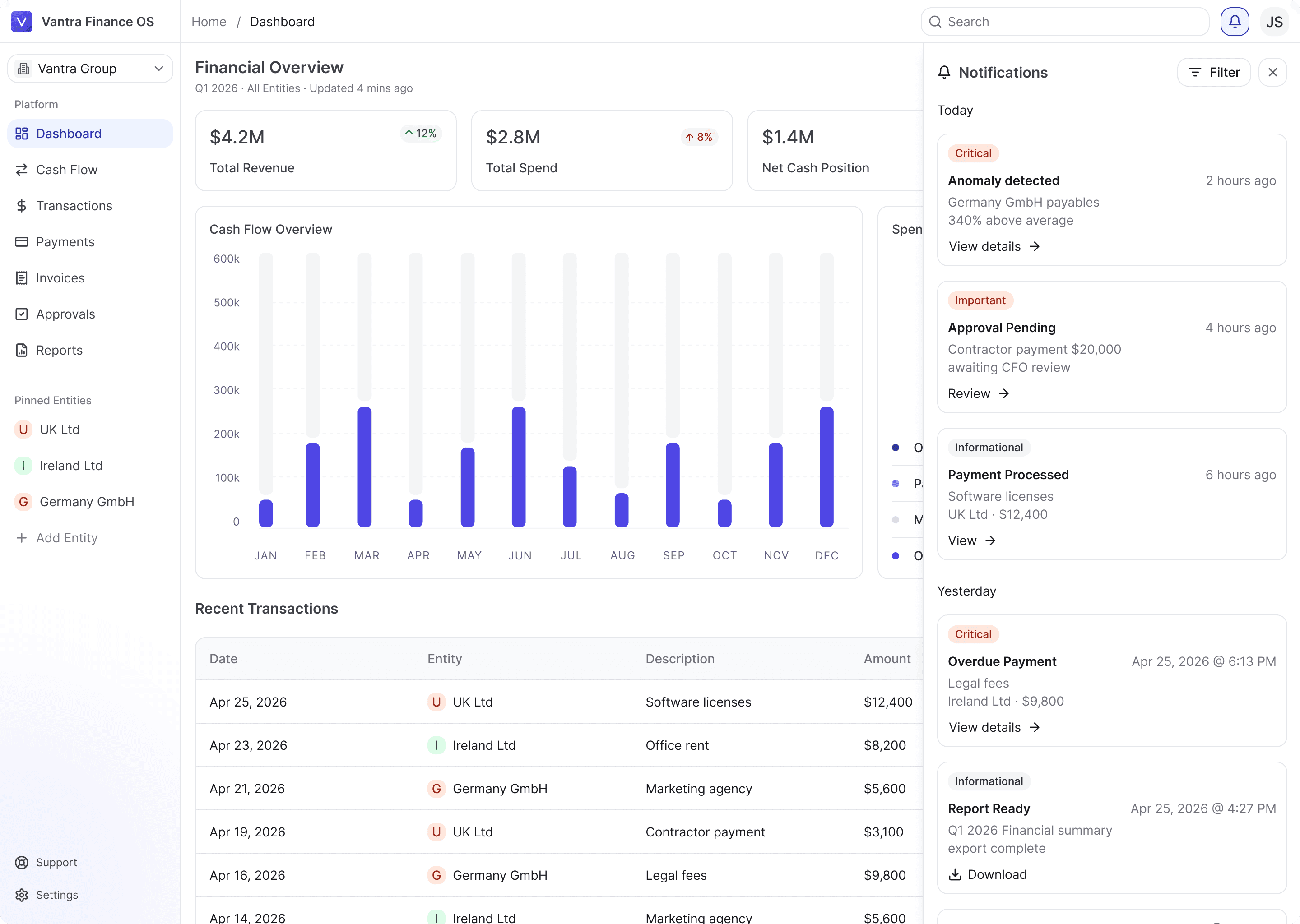
Connects to what the team already uses.
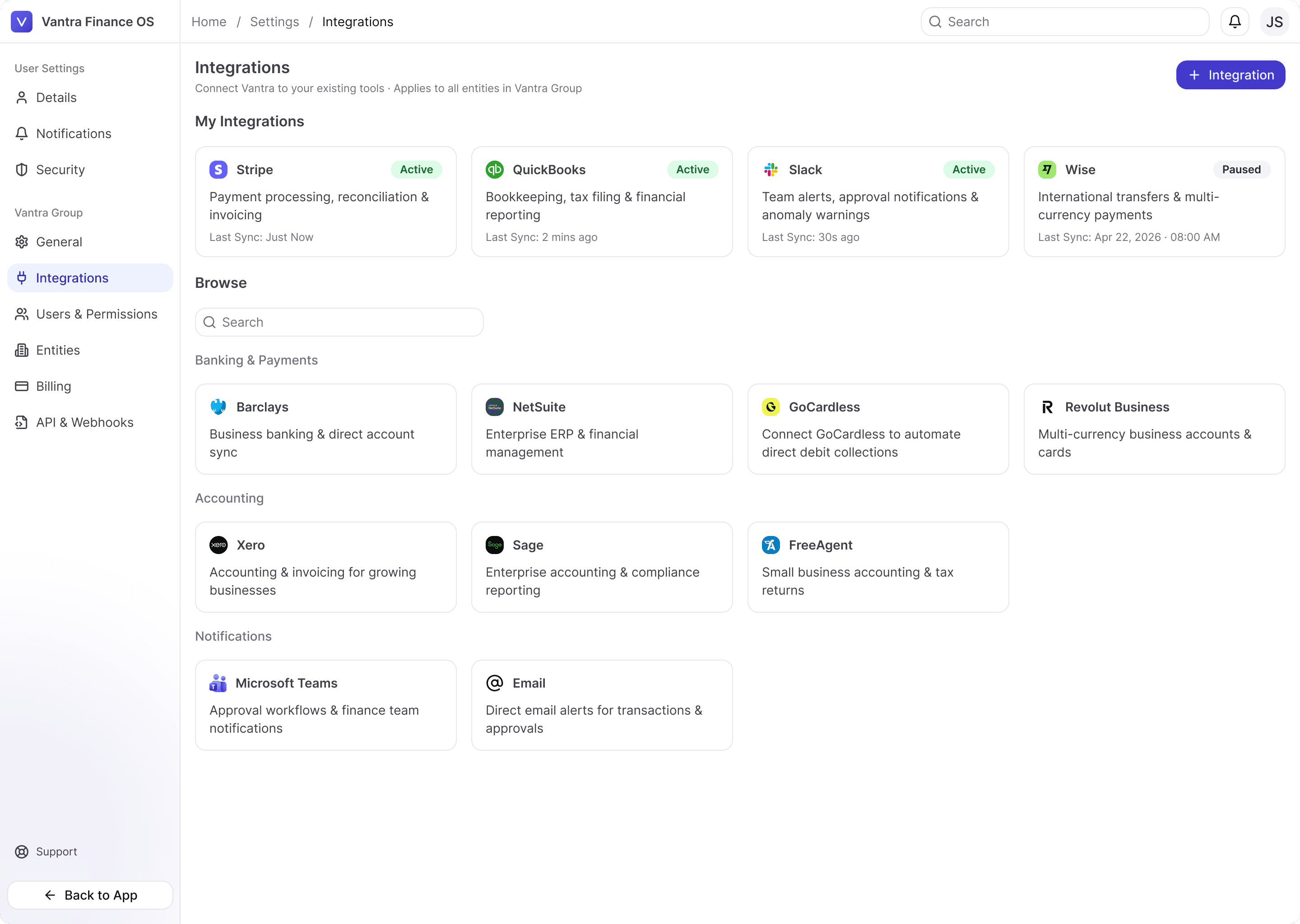
The tool sprawl problem only gets solved if Vantra sits at the centre of the finance stack. The integrations layer connects Stripe, QuickBooks, Xero, Sage, and Slack out of the box — sync state visible at a glance.
Designed so non-technical finance admins can set up and manage connections themselves — no engineering ticket required. Every integration applies across all entities simultaneously.
Numbers that changed how the business runs.
Measured across the pilot group — controllers, finance managers, and CFOs at companies with 3–12 legal entities.
Controllers were burning 3.1 days a week stitching data from four tools into a spreadsheet. After launch, the same work takes 4.2 hours. A 94% reduction — and the Monday ritual that finance teams dreaded for years is simply gone.
Manual consolidation across 4 tools — eliminated entirely. Reports that took hours now generate in seconds, in a consistent format every time.
Down from 4 hours. The Monday meeting became a decision meeting. Leadership stopped waiting for data and started acting on it.
Designing for trust, not just usability.
Finance software lives or dies on whether people trust it with their actual numbers. Usability is table stakes. Trust — earned through familiar patterns, clear data, and predictable behaviour — is the hard part.
Controllers had been living in spreadsheets for years. The biggest design mistake we could have made was ignoring that. We mapped the new interface to existing mental models — column structures they recognised, terminology they already used. Adoption moved faster because the product didn't feel like a foreign system being imposed on them.
One of our early concepts was faster on paper — users completed tasks quicker in testing. But they were also less confident in what they'd done. Confidence matters more than speed in financial workflows. We made the slower, clearer choice and it held up at 3 months.
We scoped research around controllers — the daily users. But the product's value had to land with CFOs, who'd approve the budget and champion it internally. Designing for one without designing for the other would have killed adoption. We pushed for an executive-level reporting view mid-project — it wasn't in the original brief, but it became one of the most-used features at launch.
We cut bulk-edit from v1. Not because it wasn't valuable — it was — but because we had the data to know reconciliation had to be right first. A design agency that can defend scope decisions with research rather than opinions is the difference between a smooth launch and a stalled one. The feature shipped in v1.2 and landed better for having waited.
Relay
Redesigning approval workflows for distributed finance teams — 94% reduction in overdue approvals, 12-hour average resolution time.