Hail in fourteen minutes. Nine to move the plant.
Albedo, operations software for utility-scale solar. It shows what a storm will cost before it arrives, stows each block just in time, and follows the damage all the way to a fixed plant.
- Scope
- Flow, product, rules
- Surface
- Control room web
- Hard part
- A plant of 4,592 trackers, drawn live
- Deliverable
- Coded screens, recorded flows, a live plant
A warning with minutes in it, and a plant that needs nine.
At 15:24 a hail cell was heading for Los Arcos, 248 MWp in Badajoz. Every tracker stowed too early is power the plant stops selling. Every one stowed too late is a row of cracked glass.
Minutes a block of trackers needs to reach 60°
Trackers moved, block by block, each before its hail
MWh given up on purpose, shown before the click
Trackers caught flat, replayed with the new rule, down from 3
Each block stows just before its hail.
Not all at once. D at 15:25, C at 15:45, B at 15:53, so the rest of the plant keeps producing while the cell crosses. Drag the afternoon.
Los Arcos · 248 MWp · Thursday 17 September
15:20
- Output
- 198.6 MW
- Trackers at 60°
- 0 / 2,758
Wide strips are tracking the sun. A thin blue line is a tracker at 60°. Orange is moving, or not answering.
One storm, every screen.
Every number matches across screens: 248 MWp, 2,758 trackers, 58 MWh, 14 silent, 41 cracked, 0 on the ones that stowed.
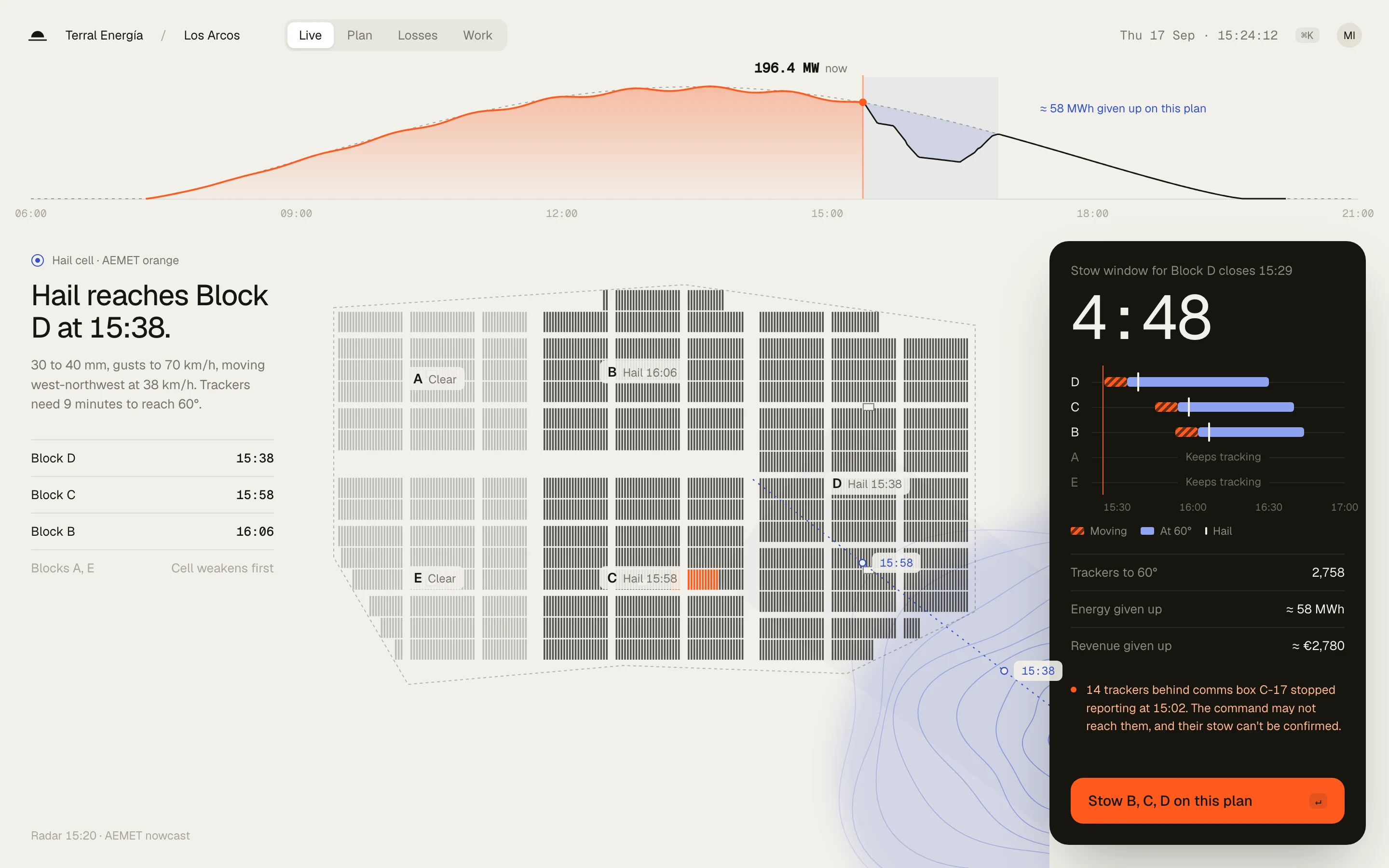
A plan per block, with the hail on each line
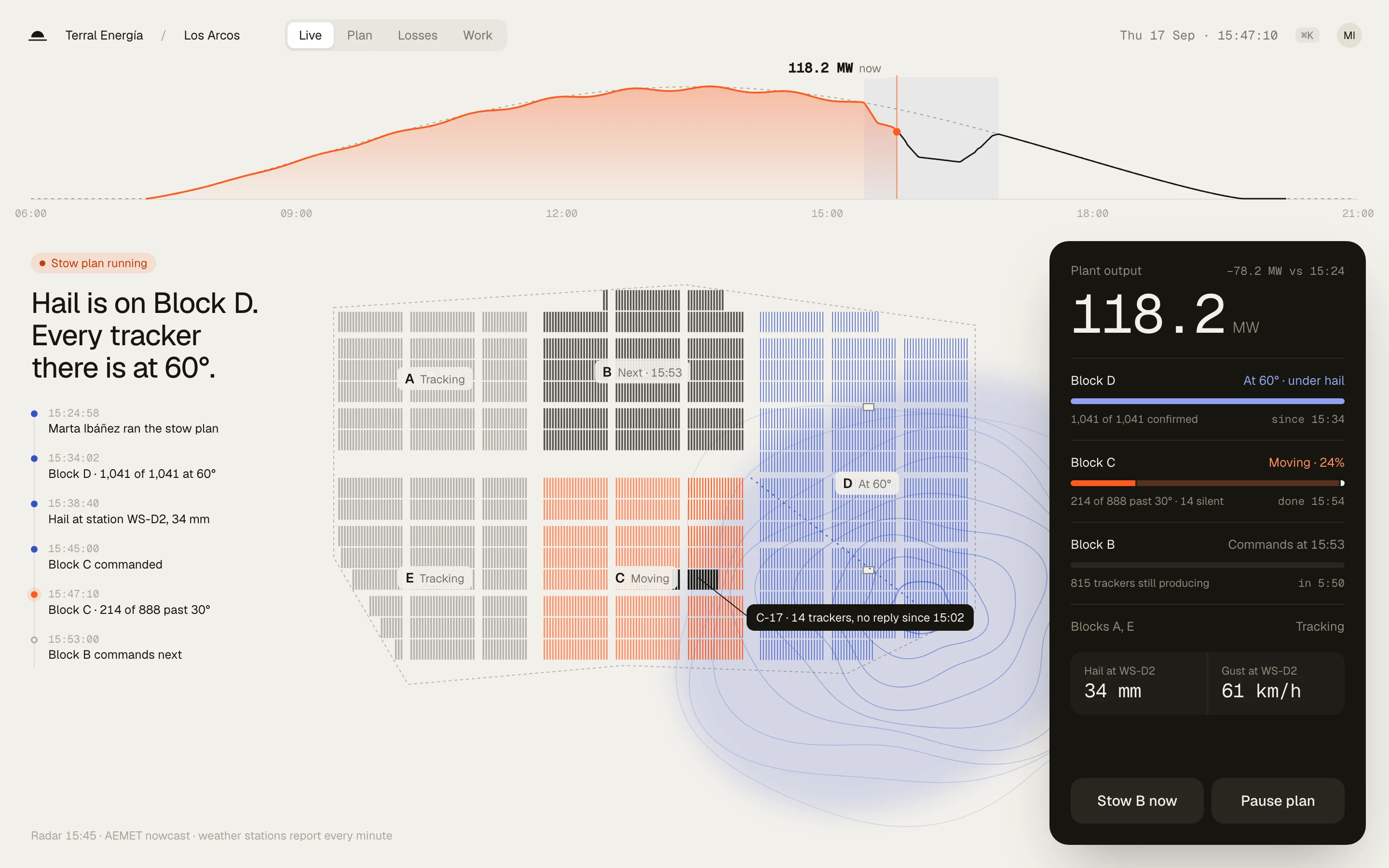
Confirmed, moving, silent, still producing
58 MWh was a choice. The other 86 were not.
Losses read as a chart you can open, so Friday starts with the one that pays to fix: two blocks the storm never rinsed.
Cleaning A and E pays back in 7 days. The rain forecast says nobody else will do it.
41 cracked modules. 0 on the trackers that stowed.
A drone flies the 14 trackers that went silent. Three never got the command. The eleven beside them are clean.
The same flight becomes the insurer's evidence pack
A fixed plant, and a rule so it never happens twice.
The work order picks the day the parts and the weather allow. The rule pages the site manager the minute a comms box goes quiet in a warning.
Monday, because the breaker arrives at 08:00
Replayed on Thursday: 3 trackers caught flat become 0
The storm on one board, before a pixel.
One FigJam: the brief, Thursday as it stood, the tensions, Thursday rebuilt, the screen map and who hears what. Every number on it made it into the product.
Thursday rebuilt: every moment points at the screen that handles it
As it stood
Three tensions
Seven screens, three ways in
Only two moments interrupt anyone
Three calls made before a screen was drawn.
Each one has a price, and the price is written down.
- 01
Stow each block just in time, not the whole plant
Albedo times every block to reach 60° four minutes before its hail, so the rest keeps selling power. The cost: if the cell speeds up, those four minutes are the whole margin.
- 02
Show what stowing costs next to the button
Energy and revenue given up sit beside the command. The cost: on a real warning, the operator reads a number they would rather not see.
- 03
A tracker that does not answer is never counted as safe
Silent trackers stay orange until a person or a drone confirms them. The cost: more alerts on days when a comms box flickers.
Three assumptions that need evidence.
With control room operators and site managers, on recorded storms, with tasks rather than opinions.
- Assumption 1
The margin
Is four minutes enough when a cell speeds up, or do operators stow early anyway?
- Assumption 2
The cost line
Does seeing €2,780 next to the button make anyone hesitate on a warning that is real?
- Assumption 3
The page
Will a site manager act on rule 03 at 15:03, or wait for the control room to call?
Which decision in your product runs against a clock?
We find the decision your screen should be making, and hand it back designed in five days.