Creative AI
40 ads by the afternoon. One promised a feature that didn’t exist.
Proof, a studio where a marketing team makes ad variants with AI. Every ad is checked against the brand before anyone sees it. Proof fixes the small things itself and brings a person only what needs judgment.
- Scope
- Flow, product, how the AI behaves
- Surfaces
- Studio on the web, approvals on the phone
- Hard part
- Knowing what a person must see
- Deliverable
- Coded product, recorded flows
00Overview
A campaign that goes live at six in the morning.
Kestrel, an app for running after dark, launches Night Miles on Meta and TikTok on Thursday at 06:00. On Wednesday afternoon the team has a brief, 22 photos and three people who sign off.
Ads Proof made from the brief: 8 concepts in 5 formats
Brand rules every ad is checked against
Minutes to make all 40
Ads that needed a person, in three issues
01The miss
The ad promised a coach. Kestrel doesn't have one.
In three Riverside ads the generator put a phone showing Live pace coach. It looked exactly like Kestrel, which is why nobody would catch it on a thumbnail. Proof checks every screen against the app's own library.
The loupe goes over the one thing a person has to judge
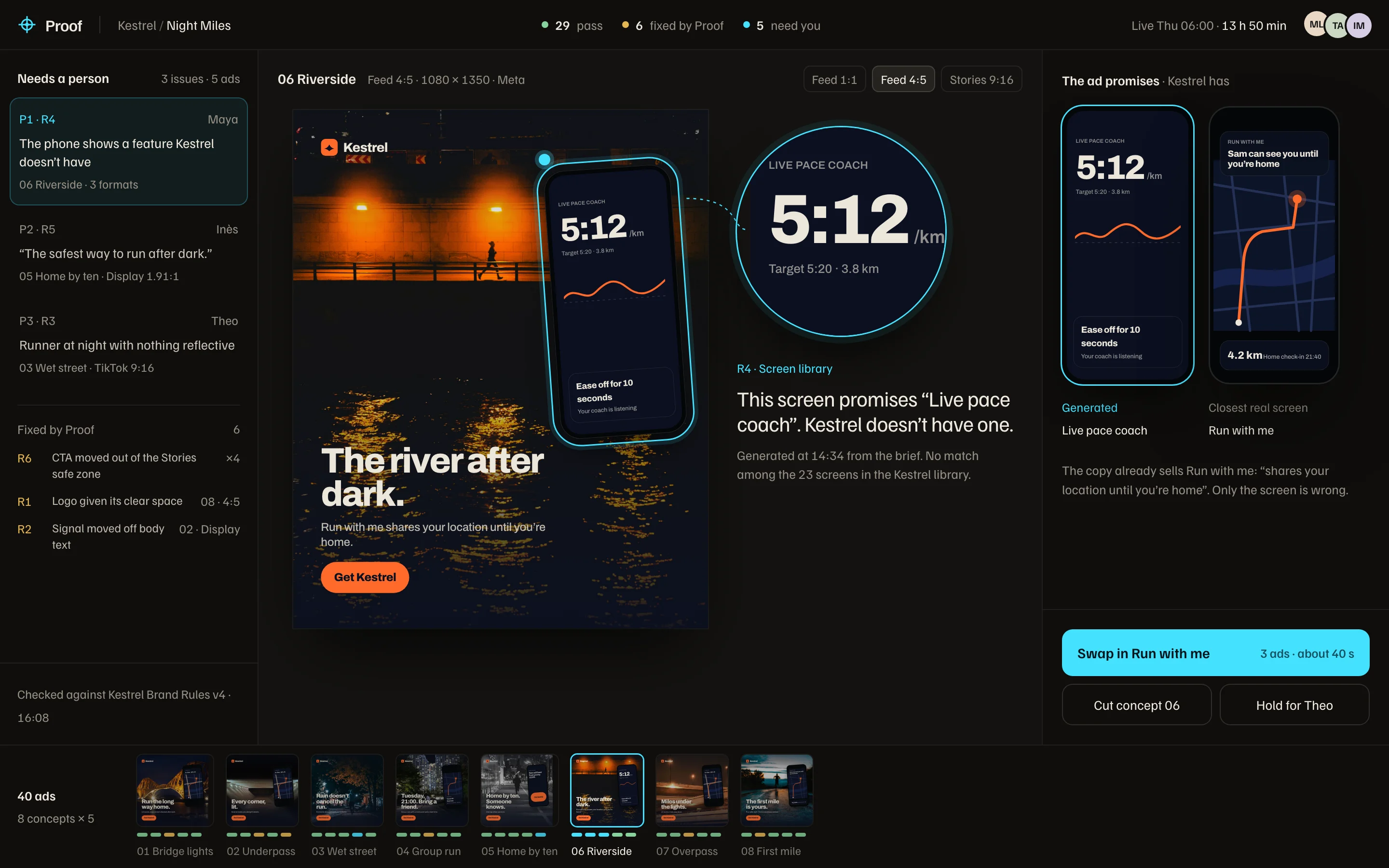
Ringed where the ad shows it
What the ad promises, next to what the app has
02The day
From a brief at two to an approval at five.
Every number matches across screens: 40 ads, 29 passed, 6 fixed by Proof, 5 for a person, 3 decisions.
03Three people
Maya fixes the screen. Inès fixes the claim. Theo signs off.
Each issue goes to the one person who owns it. Legal reads the line, not the photo. The brand lead decides between meetings, on his phone.
Inès, legal: “safest” is a comparison Kestrel can’t back up
Theo, brand: one frame to judge, then the whole campaign
04The impact
The first campaign with Proof.
Kestrel's marketing team in the quarter before Proof and on Night Miles. The same three people, and nobody reviewed all 40.
A 40-ad round, from brief to approval
Ads that went live with a brand or claim problem
Ads a person had to open
Ads that passed all 8 rules as they were made
Fixed by Proof without asking: safe zones, clear space, colour. Every fix listed
Calls made by people: a screen, a claim and a frame
From the product’s scenario: Kestrel, Q3 2026 before Proof and the Night Miles campaign with it.
05Decisions
Three calls made before a screen was drawn.
Each one has a price, and the price is written down.
- 01
Proof fixes the small things, a person decides the rest
A CTA in a safe zone, a logo without clear space, a colour off the palette: Proof fixes them and lists what it did. Anything about what an ad says or shows goes to a person. The cost: someone still opens five ads in a campaign that could have shipped with none.
- 02
A phone in an ad shows only a screen the app has
The generator can draw any screen, so an ad can promise anything. Proof allows only the 23 screens in Kestrel's library. The cost: a new feature cannot be advertised until its screen is in the library.
- 03
Each issue goes to the person who owns it
Screens to Maya, claims to Inès, the brand to Theo. Nobody reviews all 40. The cost: three people instead of one, and the campaign waits for the slowest answer.
06What we test next
Three assumptions that need evidence.
With marketing teams, brand leads and in-house lawyers, on real campaigns with names removed, with tasks rather than opinions.
- Assumption 1
The loupe
Does a reviewer trust one ringed problem, or open all 40 ads anyway?
- Assumption 2
The fixes
Will a brand lead accept six changes Proof made without asking, if every one is listed?
- Assumption 3
The phone
Will a brand lead approve a whole campaign from a phone, between two meetings?
Where does a person have to sign off what your AI made?
We design the moment someone checks what the model produced, and hand it back designed in five days.